October 19, 2026
ICOM Europe at UMAC 2026: Strengthening Collaboration for Sustainable Development through University Museums Conference, Network
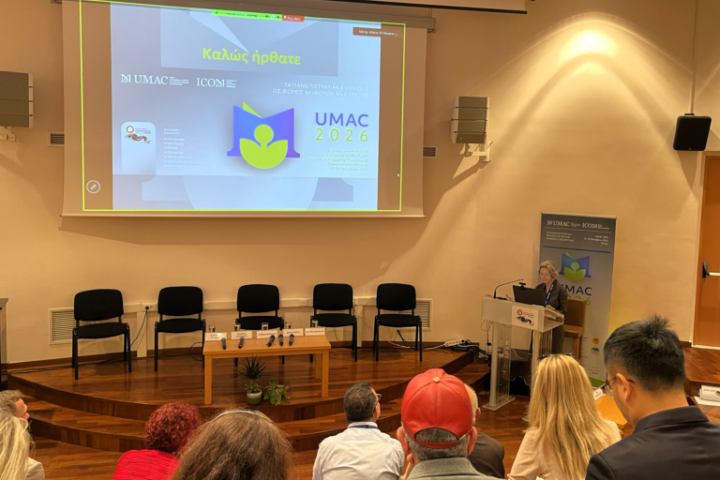
12–16 October 2026 | Patras and Athens, Greece
ICOM Europe participated as a partner in the 2026 Annual Meeting of ICOM’s International Committee for University Museums and Collections (UMAC), held from 12 to 16 October 2026 in Greece under the theme “University Museums as Actors for Sustainable Development.”
Hosted by ICOM Greece and the Science and Technology Museum of the University of Patras, in collaboration with ICOM-UMAC and international partners, the conference brought together museum professionals, researchers and representatives of the international museum community to explore the contribution of university museums and collections to the United Nations Sustainable Development Goals (SDGs).
ICOM Europe was represented by three members of its Board: Juliette Raoul-Duval, Chair; Lana Karaia, Vice-Chair; and Teti Hadjinicolaou, Secretary, who contributed to the conference through opening remarks, scientific presentations, session moderation and discussions on international museum cooperation.
ICOM Europe’s Commitment to Collaboration and Sustainability
At the opening ceremony on 12 October, ICOM Europe Chair Juliette Raoul-Duval welcomed participants and reaffirmed the Regional Alliance’s support for initiatives fostering scientific exchange, professional dialogue and cooperation across the international museum community.
In her address, she acknowledged the longstanding commitment of ICOM Greece to advancing museum research, professional standards and multilingual dialogue, while emphasising the importance of university museums in connecting scientific knowledge with wider society.
Drawing on her professional experience in a university museum, she highlighted the essential role of scientific and technical culture in addressing contemporary environmental and societal challenges. In a context marked by climate change, environmental risks and the spread of misinformation, museums have a particular responsibility to strengthen scientific literacy, encourage critical thinking and make reliable knowledge accessible to the public.
Her address also underlined the significance of ICOM’s Regional Alliances in facilitating cooperation beyond national borders. Challenges such as climate change, sustainable development and threats to cultural heritage require coordinated responses, making collaboration between national and international committees particularly important.
For ICOM Europe, supporting UMAC 2026 reflected its commitment to connecting museum professionals, encouraging the exchange of knowledge and strengthening partnerships across Europe and beyond.
Read the full opening address by Juliette Raoul-Duval, Chair of ICOM Europe (English translation).
Active Contributions from the ICOM Europe Board
ICOM Europe’s participation extended throughout the conference’s scientific programme, with Board representatives contributing to discussions addressing the educational, cultural and societal responsibilities of university museums.
On 12 October, Juliette Raoul-Duval co-chaired the session “The Value of University Collections in Integrating the SDGs” alongside Ioannis Iliopoulos, Director of the Science and Technology Museum of the University of Patras. The session examined the potential of university collections as resources for education, research, inclusion, digital accessibility and sustainable museum practices.
On the same day, Teti Hadjinicolaou, Secretary of ICOM Europe co-chaired the session “University Museums and Collections Engaging the Educational Community and the Public for the SDGs” with Giovanna Vitelli, Vice-Chair of UMAC. The presentations explored how university museums can engage diverse audiences, support participatory learning, safeguard heritage and contribute to community wellbeing.
On 13 October, Lana Karaia, Vice-Chair of ICOM Europe, presented her paper “Reframing a University Art Museum as a Platform for Sustainable Development: The Case of Apollon Kutateladze Tbilisi State Academy of Art.”
Focusing on the University Museum of the Apollon Kutateladze Tbilisi State Academy of Arts in Georgia, the presentation explored how institutional transformation can integrate sustainability into museum development. The case study highlighted the rehabilitation of a nineteenth-century historic palace through academic collaboration, alongside emerging strategies for object-based learning, interdisciplinary research, digital transformation and public engagement. It emphasised sustainability as an integral part of museum governance, education and heritage preservation, contributing to SDGs 4, 9 and 11.
From Collections to Collaboration: Strengthening International Partnerships
An important contribution to the conference was the roundtable “From Collections to Collaboration: Supporting Sustainability,” held on 14 October.
Moderated by Penelope (Peny) Theologi-Gouti, Chair of ICOM Greece, and Sébastien Soubiran, Chair of UMAC, the discussion brought together representatives of ICOM’s National and International Committees, Regional Alliances and university museum networks.
Juliette Raoul-Duval, Chair of ICOM Europe, participated alongside Émilie Girard (ICOM France), Marion Bertin (ICOFOM) and Esther Boeles (UNIVERSEUM).
During the discussion, Juliette Raoul-Duval highlighted ICOM Europe’s role in promoting cooperation between National Committees, supporting professional exchange and encouraging joint initiatives that address shared challenges across the museum sector.
She illustrated this commitment through examples of events and partnerships supported by ICOM Europe in recent years, including the Second Forum of Students and Young Museum Professionals, organised in October 2026 in cooperation with ICOM Africa and ICOM Seychelles, focusing on the sustainable management of museum collections in the context of climate change and the role of young professionals.
Other examples included initiatives addressing museums, tourism, innovation and sustainability in Málaga (2024); the relationship between museum collections and social responsibility in Pontevedra (2025); the future of museums in Abu Dhabi (2025); museums in times of uncertainty in Trenčín, Slovakia (2026); and the cross-border initiative “Museum Borderless” in Gorizia-Nova Gorica, the European Capital of Culture 2025, developed through cooperation between ICOM Italy and ICOM Slovenia.
These examples demonstrated the diversity of ICOM Europe’s partnerships and its commitment to connecting museum professionals across geographical, institutional and disciplinary boundaries.
The roundtable also provided an opportunity to reflect on the importance of strengthening cooperation between ICOM’s Regional Alliances, National and International Committees, and other professional networks. Such collaboration is essential not only for the preservation and accessibility of collections, but also for addressing wider challenges related to climate change, cultural heritage protection, social responsibility and sustainable development.
For ICOM Europe, the discussion reaffirmed that sustainability is a shared responsibility requiring long-term partnerships, international solidarity and coordinated action across the museum community.
Exploring University Museums and Cultural Heritage in Greece
In addition to the scientific sessions, the conference programme provided opportunities to explore university museums and collections in Greece and their diverse approaches to education, heritage preservation and public engagement.
At the University of Patras, the museum visits included the Science and Technology Museum, the Zoological and Botanical Museums, and the Museum of Education. The visits offered insights into the educational and research roles of university collections, as well as their potential to engage communities through exhibitions and public programmes.
The programme continued on 15 October with a visit to the Stymphalia Environment Museum, highlighting the relationship between environmental heritage, local communities and sustainable development.
On 16 October, the conference concluded with visits to museums of the National and Kapodistrian University of Athens, including collections relating to archaeology, history of art, folklore, palaeontology, geology and mineralogy, as well as the University of Athens History Museum.
These visits complemented the conference discussions by demonstrating the diversity of university museum collections and their potential to connect academic research, cultural and natural heritage, and public education.
Advancing a Shared Vision for Sustainable Museums
ICOM Europe’s participation in UMAC 2026 reaffirmed the importance of cooperation between ICOM’s Regional Alliances, National Committees and International Committees in addressing challenges shared by the museum sector.
The conference highlighted the contribution of university museums not only as custodians of scientific, artistic and cultural heritage, but also as active spaces for education, critical inquiry, innovation and public participation.
Through its partnership and the active involvement of its Board representatives, ICOM Europe supported the exchange of professional knowledge and the development of international dialogue on sustainability, inclusion and the social responsibilities of museums.
ICOM Europe extends its appreciation to ICOM Greece, ICOM-UMAC, the Science and Technology Museum of the University of Patras, and all organising partners for their commitment to bringing the international museum community together around a shared vision of sustainable development.
For further information, visit the official UMAC 2026 conference website and consult the conference programme.