March 1, 2026
Call for Papers: University Museums as Actors for Sustainable Development – ICOM-UMAC Annual Meeting 2026 Call, Conference
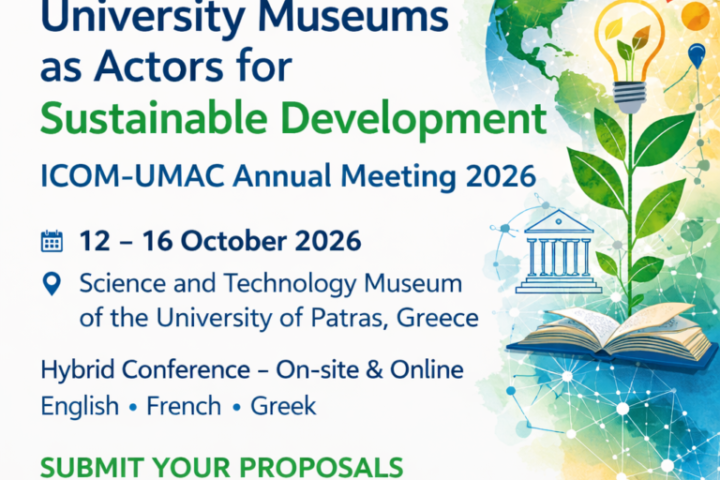
Call for Papers: University Museums as Actors for Sustainable Development – ICOM-UMAC Annual Meeting 2026
ICOM Europe invites its members and the wider museum and academic community to submit proposals for the 2026 Annual Meeting of the International Committee for University Museums and Collections (ICOM-UMAC), a committee of the International Council of Museums.
The conference will take place 12–16 October 2026 at the Science and Technology Museum of the University of Patras, hosted by ICOM Greece in Patras, Greece.
The event is organised by ICOM-UMAC and ICOM Greece in partnership with ICOM Europe and ICOM Africa, with the support of the National Committees ICOM France, ICOM Burkina Faso and ICOM South Africa, as well as the International Committee ICOFOM.
The conference will be held in a hybrid format (on-site and online).
Conference languages: English, French and Greek.
Conference Theme
Universities play a key role in advancing the United Nations Agenda 2030 and the Sustainable Development Goals (SDGs) by integrating them into teaching, research and institutional practices. As centres of knowledge production and innovation, universities contribute significantly to sustainable development across sectors.
Within this context, university museums and collections are uniquely positioned to support these objectives. Through their collections, exhibitions and research activities, they help translate academic knowledge into accessible public engagement with sustainability issues.
University museums facilitate access to the cultural, scientific, technological and environmental heritage of universities while serving as important resources for education, research and lifelong learning. They also provide valuable learning environments for university students, school pupils and teachers, as highlighted in Resolution 4 – Empowering Museums in Achieving the SDGs through Youth, adopted at the ICOM General Conference Dubai 2025.
Through exhibitions, outreach programmes and museum education initiatives, university museums can engage diverse audiences in areas such as:
- climate action
- wellbeing and prosperity
- human rights and inclusion
- peacebuilding
- sustainable practices and lifestyles
By doing so, they strengthen partnerships and contribute to the effective implementation of the SDGs.
The UMAC 2026 conference will explore how university museums and collections worldwide are becoming active contributors to sustainable development, supporting education, research and community engagement while showcasing universities’ sustainability initiatives. These institutions bridge academic knowledge with public understanding and action on global challenges such as climate change, social justice, environmental risks and cultural heritage preservation.
Key Conference Question
How can university museums strengthen the role of universities as actors for sustainable development?
Sub-themes
Contributions are invited addressing the following themes:
- The value of university collections in integrating the SDGs
- University museums and collections engaging educational communities and the public for the SDGs
- University museums and collections at the forefront of universities’ sustainability strategies
- University museums’ contribution to education on sustainable development in contexts facing security, environmental risks and climate challenges
- North–South cooperation to strengthen the role of university museums in implementing the SDGs
Paper and Poster Proposals
The organisers invite contributions addressing all aspects of the conference theme. Proposals are welcome in the following formats:
Paper Presentations
Paper presentations may address any aspect of the conference theme and its five sub-topics.
Speaking time is strictly limited to 15 minutes. Papers will be grouped into thematic panels with time for discussion at the end.
Flash Talks
Flash talks offer participants the opportunity to present projects, topics or questions related to the conference theme in a concise format.
Speaking time is strictly limited to 5 minutes. Flash talks will be grouped into thematic panels with time for discussion.
Posters
A poster session will showcase ongoing projects in the academic heritage community. All topics are welcome. Posters will be exhibited physically and should be printed in A1 portrait format (594 mm × 841 mm).
Project Speed Dating
This newly launched format offers individuals or teams the opportunity to present new projects or project ideas to potential partners or collaborators.
Speaking time is strictly limited to 5 minutes. Presentations will be grouped into a panel followed by time for one-to-one exchanges.
Round Tables
Round tables provide the opportunity to address key topics from a broader perspective. Short keynote contributions will serve as a starting point for a joint discussion with the audience.
Proposals are invited for short keynote contributions addressing the following themes:
- University strategies on Sustainable Development and university museums
- Educating for sustainable development in contexts facing security and climate challenges
- Empowering youth to achieve the SDGs
Keynote speaking time is strictly limited to 5 minutes, and each round table will include 3–4 speakers.
Submission Guidelines
What to Submit
Proposals for paper presentations, posters, flash talks, project speed dating and round tables should include:
- Title
- Abstract (maximum 250 words)
- Short biographical note (maximum 50 words)
- 3–5 keywords
Where to Submit
The submission and application procedure will be announced shortly.
Deadline
The deadline for abstract submissions is 29 March 2026.
All proposals will be reviewed by an international scientific programme committee.
Successful applicants will be notified by 10 May 2026.